compliance
Why Banks Close Crypto Company Accounts (And How to Keep Yours)
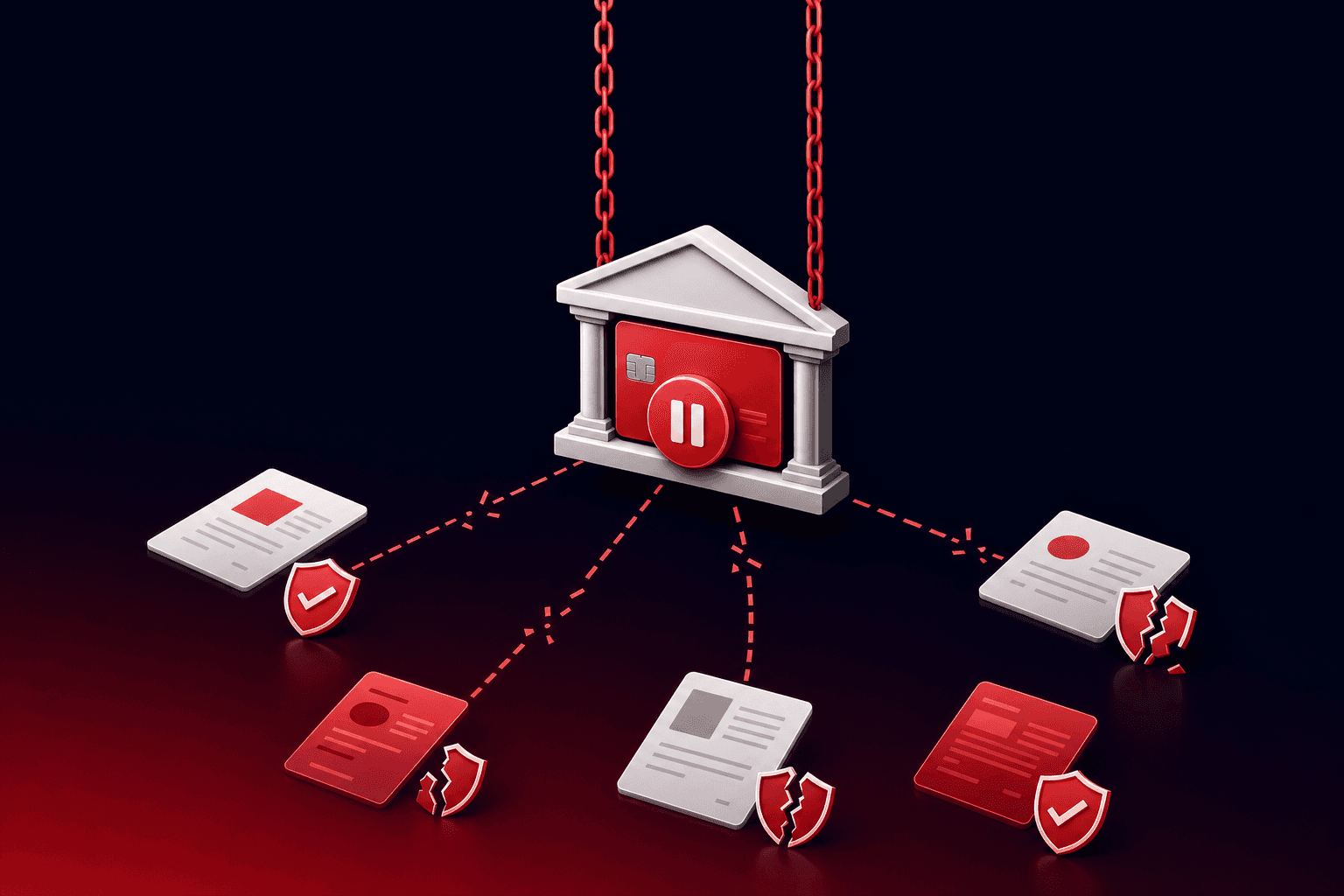
Most crypto firms lose banking access not from fraud, but from appearing operationally unpredictable. Banks close accounts when they can't explain your activity to regulators — even if everything you're doing is legal.
REDFi
On this page (10 sections)
- The Real Reason Banks Exit Crypto Relationships
- What Banks Actually Monitor in Crypto Accounts
- Why Rapid Growth Triggers De-Risking
- The Myth of "Crypto-Friendly" Banks
- How Fragmented Operations Create Compliance Blind Spots
- What Compliance-First Infrastructure Actually Looks Like
- How REDFi Reduces De-Risking Vulnerability
- The Questions Your Bank Will Ask — And How to Answer Them
- When to Worry About Your Banking Relationship
- Building a De-Risking-Resistant Business
The Real Reason Banks Exit Crypto Relationships
Your crypto company just received the email: "We've decided to exit our banking relationship with your organization. Please withdraw all funds within 30 days."
No fraud. No regulatory violation. No warning. Just a sudden account closure that threatens payroll, vendor payments, and operational continuity.
This scenario plays out hundreds of times per year across the crypto industry. But the reason isn't what most founders think.
Banks don't close crypto accounts because they hate crypto or because regulators forbid it. They close accounts when they can't confidently explain your business activity to their own compliance teams and examiners — even when everything you're doing is perfectly legal.
The trigger is perceived unmanaged risk, not actual wrongdoing.
What Banks Actually Monitor in Crypto Accounts
Traditional banks evaluate crypto relationships through a compliance lens that prioritizes predictability over innovation. Their risk teams track four categories of signals:
Transaction narrative consistency. Every wire, ACH, or SWIFT transfer requires a purpose description. Banks flag accounts where these narratives are vague ("business operations"), inconsistent across similar transactions, or don't match the company's stated business model. If your payment descriptions change weekly or contradict your account opening documentation, you look operationally chaotic.
Fund source traceability. Banks must demonstrate to regulators that they know where money originates. Crypto companies that commingle customer funds with operational capital, mix stablecoin redemptions with service revenue, or route funds through multiple intermediary accounts create audit trails that banks can't defend. The more hops between source and destination, the harder you are to explain.
Jurisdictional exposure patterns. Cross-border payments to high-risk jurisdictions trigger enhanced due diligence. But even low-risk countries become problematic if your payment geography doesn't match your documented customer base or business plan. A U.S.-incorporated company suddenly sending 40% of outbound volume to Eastern Europe without explanation signals loss of operational control.
Explanation quality under pressure. When a bank's compliance team asks "Why did you send $250K to this counterparty?" they expect a specific answer within hours, not days. Crypto companies that can't quickly produce transaction-level documentation — invoices, contracts, KYC records for the recipient — demonstrate that their internal controls can't keep pace with their transaction volume.
Banks don't need you to be slow. They need you to be explainable.
Why Rapid Growth Triggers De-Risking
Counterintuitively, fast growth often precipitates account closures for crypto companies. Growth itself isn't the problem — it's growth that outpaces compliance infrastructure.
A crypto business that triples transaction volume in 90 days while still using the same spreadsheet-based compliance workflow from six months ago sends a clear signal to the bank: this company has lost operational control.
Banks watch for these specific growth-risk mismatches:
Transaction volume increases without corresponding compliance staff additions. If your monthly volume goes from $2M to $20M but you still have one person manually reviewing transactions, the bank assumes you're not actually reviewing them anymore.
New payment corridors introduced without updated risk assessments. Adding SEPA payments to your existing ACH operations should trigger internal policy updates, enhanced due diligence procedures, and new monitoring rules. If you just start sending SEPA transfers without documenting how you've adjusted controls, the bank sees reckless expansion.
Customer onboarding speed that exceeds reasonable KYC timelines. Onboarding 500 new business customers in a week is possible with automation — but only if your KYC process is demonstrably robust. If you can't show the bank your identity verification workflow, automated sanctions screening, and risk-scoring logic, rapid customer growth looks like abandoned due diligence.
Increased international exposure without jurisdiction-specific compliance policies. Expanding from U.S.-only operations to serving customers in 40 countries requires country-level risk assessments, updated AML policies, and jurisdiction-specific transaction monitoring rules. Banks expect to see this documentation. If you can't produce it, your international expansion looks improvised.
The pattern banks fear most: a crypto company that's scaling faster than its ability to answer compliance questions.
The Myth of "Crypto-Friendly" Banks
Many crypto companies believe the solution to de-risking is finding a "crypto-friendly" bank — one that explicitly serves blockchain businesses and understands the industry.
This is partially true but dangerously incomplete.
Crypto-friendly banks still operate under the same regulatory framework as traditional banks. They still file Suspicious Activity Reports, respond to the same examiner questions, and face the same penalties for compliance failures. The difference is they've built internal expertise to evaluate crypto business models — but that expertise makes them more discerning, not more lenient.
A crypto-friendly bank will close your account faster than a traditional bank if you demonstrate poor operational controls, because they know exactly what good crypto compliance looks like and can spot the gaps immediately.
These banks evaluate three factors traditional banks often miss:
Blockchain transaction monitoring integration. Do you have automated tools that flag suspicious on-chain activity before funds hit the banking system, or are you only monitoring fiat rails? Crypto-friendly banks expect you to surveil both layers.
Stablecoin reserve transparency. If your business model involves stablecoin issuance, minting, or large-volume redemptions, the bank will ask how you verify reserve backing and audit attestations. "We trust the issuer" isn't an acceptable answer.
Smart contract risk assessment processes. Banks that understand DeFi expect you to have documented procedures for evaluating smart contract security, protocol risk, and custody arrangements before integrating new blockchain services. If you can't explain your technical due diligence process, you're not ready for a crypto-friendly bank.
The advantage of crypto-friendly banks isn't that they'll tolerate weak controls. It's that they'll tell you exactly what controls they expect before they close your account.
How Fragmented Operations Create Compliance Blind Spots
Most crypto companies don't lose bank accounts from a single catastrophic failure. They lose them from accumulated small gaps that, together, make the business unexplainable.
Multiple disconnected payment tools. Your team uses one platform for ACH, another for international wires, a third for stablecoin operations, and a fourth for expense cards. No single system has a complete view of fund flows. When the bank asks "Where did this $100K deposit come from?" your team needs two days and three people to reconstruct the answer because the information lives in four places.
Manual reconciliation between fiat and crypto. You maintain separate accounting for USD bank balances and USDC holdings, reconciling them weekly in a spreadsheet. This works until transaction volume increases and the reconciliation falls behind. Suddenly you can't quickly verify that a specific bank deposit corresponds to a specific stablecoin redemption, and the bank's compliance team is waiting for an answer.
Permission structures that don't match operational reality. Your bank account has three authorized signers, but twelve people in the company can initiate payments through various tools and workflows. The bank sees unauthorized transaction patterns because your internal access controls don't align with your banking agreement.
Inconsistent vendor due diligence. You have a thorough KYC process for customers but no documented procedure for vetting payment recipients. When the bank asks "Who is this entity you sent $50K to?" you realize you never collected their business registration documents or verified their legitimacy.
These gaps compound. A bank that sees multiple unexplainable transactions, slow response times to compliance questions, and operational inconsistencies will conclude you've lost control — even if each individual issue has an innocent explanation.
What Compliance-First Infrastructure Actually Looks Like
Preventing account closures requires building compliance into operational infrastructure from day one, not bolting it on after growth.
Unified payment and treasury platform. Every transaction — whether ACH, wire, SWIFT, SEPA, stablecoin transfer, or card payment — flows through a single system that maintains complete audit trails, consistent transaction narratives, and real-time compliance monitoring. When a bank asks about a specific payment, your team can pull a complete record in seconds, not hours.
Automated transaction monitoring rules. Compliance checks run automatically on every transaction before it executes. Payments to sanctioned jurisdictions, counterparties on watchlists, or patterns that match money laundering typologies get flagged and reviewed before funds move. The bank sees that you're catching issues proactively, not reactively.
Segregated account structures. Operational funds, customer deposits, stablecoin reserves, and treasury holdings live in separate accounts with clear purposes. Banks can see exactly what each account does and verify that funds aren't being commingled inappropriately.
Role-based access controls with audit trails. Every team member has permissions that match their job function. Junior staff can view balances but not initiate payments. Finance leads can approve transactions up to certain limits. Executives have full access. The system logs every action, creating a defensible record of who authorized what.
Documented compliance policies that match actual operations. Your AML policy, KYC procedures, and transaction monitoring rules aren't generic templates — they describe exactly how your business actually operates. When the bank asks "How do you verify customer identities?" you can point to a specific documented workflow that matches what your team does daily.
This infrastructure doesn't slow operations down. It makes them defensible.
How REDFi Reduces De-Risking Vulnerability
REDFi's platform is designed specifically to address the operational patterns that trigger bank account closures for crypto companies.
Unified fiat and stablecoin operations. USD virtual accounts and USDB/USDC/USDT stablecoin balances live in the same platform. You can send international wires via SWIFT, local payments via ACH/SEPA/PIX/SPEI, and stablecoin transfers — all from one interface with consistent transaction narratives and complete audit trails. No reconciliation gaps between systems.
Built-in compliance controls. Every transaction runs through automated sanctions screening, jurisdiction risk checks, and transaction monitoring rules before execution. Your team doesn't need to remember to check watchlists manually — the platform enforces compliance at the infrastructure level.
Segregated multi-account structures. Create separate virtual accounts for different business functions (operations, payroll, customer funds, treasury) with clear purposes and isolated fund flows. Banks can see exactly what each account does without needing lengthy explanations.
Granular permission management. Assign role-based access controls to team members with different authority levels. Junior staff can view balances and request payments. Managers can approve transactions up to defined limits. Executives have full control. Every action is logged with timestamps and user attribution.
Explainable transaction flows. When you send an international wire, the platform maintains a complete record: who initiated it, who approved it, what documentation supports it, and how it connects to other transactions. If a banking partner asks questions, you have instant answers backed by structured data.
REDFi Rewards on USDB balances. Earn 3% annual rewards on USDB holdings while maintaining compliance-ready treasury operations. Your idle capital generates returns without sacrificing the operational transparency banks require.
Visa debit cards backed by stablecoin balances. Issue cards to team members for operational expenses, with spending limits and category controls that create clear audit trails. Card transactions integrate into the same compliance monitoring system as your other payment flows.
The platform supports operations in 80+ countries with local payment rails (Wire, SWIFT, ACH, SEPA, PIX, SPEI, Bre-B), so you can expand internationally without creating the jurisdictional complexity that triggers enhanced scrutiny.
The Questions Your Bank Will Ask — And How to Answer Them
When a bank's compliance team reviews your crypto company account, they're evaluating whether they can defend the relationship to regulators and examiners. These are the questions they'll ask, explicitly or implicitly:
"Can you explain the source of funds for this deposit?" Answer with specificity: "This $500K deposit is a stablecoin redemption from Circle. Here's the blockchain transaction hash, the redemption request timestamp, and the corresponding USDC burn record." Not: "It's from our business operations."
"Why are you sending payments to this jurisdiction?" Answer with documentation: "We have 15 customers in that country, verified through our KYC process. Here are their business registration documents, beneficial ownership records, and service agreements." Not: "We serve customers globally."
"How do you verify the identity of payment recipients?" Answer with process: "Every new vendor completes our onboarding workflow, which includes business registration verification, beneficial ownership disclosure, and sanctions screening. Here's our documented procedure and the records for this specific vendor." Not: "We check them before paying."
"What changed in your business that caused this transaction pattern shift?" Answer with context: "We launched a new service line targeting European customers in Q2, which explains the increase in SEPA volume. Here's our updated business plan, the compliance risk assessment we conducted before launch, and the new monitoring rules we implemented." Not: "Our business is growing."
"Can you produce transaction-level documentation for these payments within 24 hours?" Answer with systems: "Yes, every transaction in our platform links to supporting documentation — invoices, contracts, KYC records. I can pull a complete audit package for any transaction in under five minutes." Not: "We'll need to check with accounting and get back to you."
Banks aren't trying to trick you. They're trying to determine whether you can help them satisfy regulators. If you can answer these questions quickly and confidently, you're not a de-risking risk.
When to Worry About Your Banking Relationship
Watch for these early warning signs that your bank is considering exiting your relationship:
Increased documentation requests. If your bank suddenly asks for detailed explanations of transaction patterns they previously accepted without question, they're building a file to either justify keeping you or defend closing your account.
Longer hold times on deposits. Funds that previously cleared in one business day now take three to five days, with vague explanations about "enhanced review." The bank is scrutinizing your transactions more carefully.
Requests for updated business plans or financial projections. Banks typically ask for these during annual reviews. If they're asking mid-year without an obvious trigger, they're reassessing your risk profile.
Questions about your other banking relationships. If the bank asks where else you hold accounts or whether you've had accounts closed, they're evaluating whether other institutions have already de-risked you.
Unexplained transaction rejections. Payments that should process normally get declined without clear reasons, or with generic explanations like "unable to process." The bank may be testing whether they can operationally exit the relationship.
Don't wait for the closure notice. If you see these signs, proactively schedule a meeting with your relationship manager to address concerns before they escalate.
Building a De-Risking-Resistant Business
Long-term banking stability for crypto companies requires treating compliance as core infrastructure, not a checkbox exercise.
Document everything in real time. Don't wait until the bank asks questions to create documentation. Build systems that automatically capture transaction purposes, supporting documents, and approval workflows as operations happen.
Maintain compliance capacity ahead of growth. If you're planning to double transaction volume in six months, hire compliance staff and upgrade monitoring tools now, not after volume increases. Banks want to see that compliance scales with operations.
Conduct regular self-audits. Quarterly, review your transaction patterns from a bank's perspective. Are narratives consistent? Can you quickly explain any unusual activity? Are your controls actually being followed? Fix gaps before the bank finds them.
Build relationships with multiple banking partners. Don't rely on a single bank account. Maintain backup relationships so an unexpected closure doesn't halt operations. But don't spread activity so thin that no bank sees enough volume to justify the compliance overhead.
Invest in compliance technology. Automated sanctions screening, transaction monitoring, and audit trail systems aren't optional for crypto companies operating at scale. Manual processes can't keep pace with transaction volume, and banks know it.
The crypto companies that maintain stable banking relationships long-term aren't the ones that avoid scrutiny. They're the ones that make scrutiny easy.
Frequently asked questions
Why do banks close crypto company accounts without warning?
Banks close accounts when they can't confidently explain your business activity to regulators, not because of wrongdoing. Vague transaction narratives, inconsistent fund flows, or slow responses to compliance questions make relationships indefensible. Banks often exit suddenly to minimize their own regulatory exposure once they've decided the risk is unmanageable.
What transaction patterns trigger bank scrutiny for crypto businesses?
Banks flag inconsistent payment descriptions, commingled fund purposes (mixing customer deposits with operational funds), unexplained jurisdictional exposure, rapid volume growth without compliance infrastructure upgrades, and inability to quickly produce transaction documentation. The pattern they fear most is growth that outpaces your ability to answer compliance questions.
Are crypto-friendly banks more lenient with compliance requirements?
No. Crypto-friendly banks understand blockchain business models better but enforce the same regulatory standards as traditional banks. They're often more discerning because they know exactly what good crypto compliance looks like and can spot operational gaps faster. They'll close accounts quickly if controls are weak.
How can crypto companies prevent banking relationship closures?
Build compliance into operational infrastructure: use unified platforms that maintain complete audit trails, implement automated transaction monitoring, segregate accounts by purpose, assign role-based access controls, and document policies that match actual operations. Banks need you to be explainable, not slow. Quick, specific answers to compliance questions prevent de-risking.
What should I do if my bank starts asking more compliance questions than usual?
Increased documentation requests, longer hold times on deposits, or unexplained transaction rejections signal the bank is reassessing your risk profile. Proactively schedule a meeting with your relationship manager to address concerns before they escalate. Provide detailed transaction documentation, updated business plans, and evidence of robust compliance controls to demonstrate operational stability.
Keep reading

Why Compliance Infrastructure Is Your Fintech Competitive Advantage
Most payment platforms treat compliance as overhead. REDFi builds it into the foundation—preventing account freezes, enabling institutional partnerships, and turning regulatory clarity into a growth engine for global businesses.
8 min read
Why Payment Rails No Longer Matter (And What Does Instead)
Speed stopped being the bottleneck. Modern cross-border payments succeed or fail on compliance infrastructure, downstream integrations, and whether your finance team can actually use the system.
8 min read
How Stablecoins and SWIFT Work Together for Global Payments
Stablecoins settle in minutes with minimal fees while SWIFT connects 11,000+ banks worldwide. Modern fintech infrastructure combines both rails to give businesses speed, cost savings, and universal reach.
9 min read